
The Book
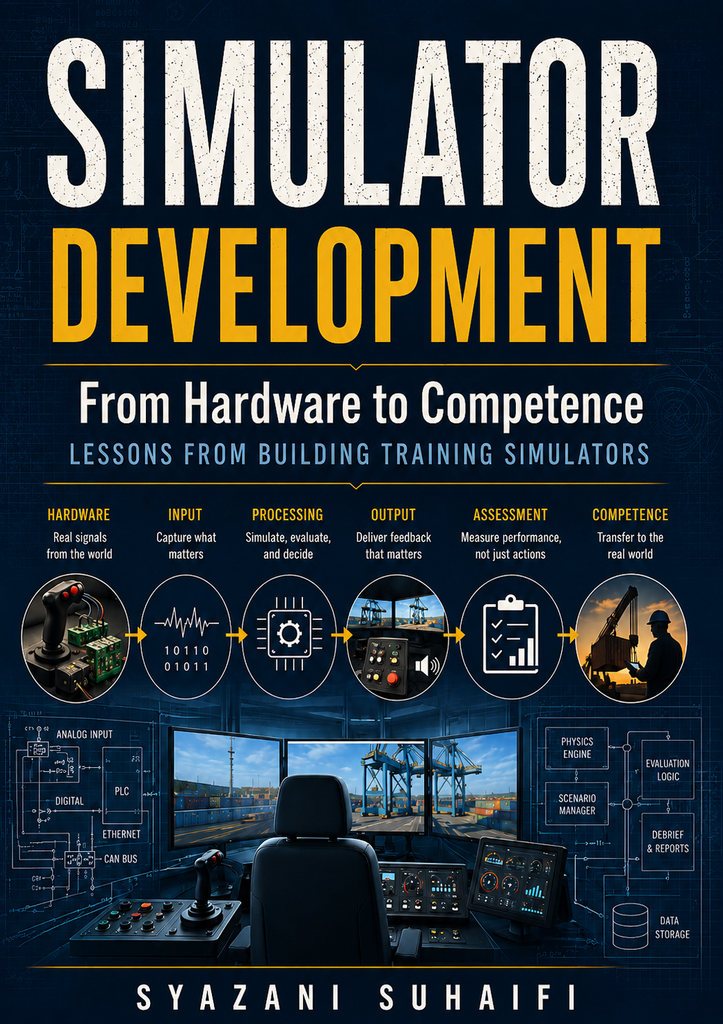
Simulator Development
From Hardware to Competence: Lessons from Building Training Simulators
by Syazani Suhaifi
Why this book exists
Too many simulator projects end the same way.
The hardware gets shipped, the client signs off, and the team moves on. Everything learned along the way, from the decisions that worked to the workarounds nobody wrote down, disappears with the people who built it. The next project starts from scratch, with the same mistakes.
Simulator knowledge is scattered across aviation, defence, industrial, maritime and medical training, buried in manuals, certification documents and the memories of experienced engineers. This book brings it together in one place: how hardware connects to software, how signals become reliable inputs, and how early architecture decisions affect a system years later.
It draws on projects that succeeded, projects that struggled, and projects Syaz was brought in to rescue after the wheels had already come off.
The purpose of a simulator is simple: to develop competence that transfers to the real world.
From the preface
Who it’s for
Software developers
You’ve been handed a hardware interface and told to make it work. This book explains what’s happening on the other side of the cable.
Hardware engineers
You’ve been asked why the software isn’t reading your signals correctly. This book shows how software sees your hardware, and where things go wrong.
Project managers
You want to know why simulator projects always seem to take longer and cost more than planned, and how to spot the risks early.
Contents
What’s inside
22 chapters, from the first button press to a complete training system.
Foundations
- What Is a Simulator?
- The IPOS Principle
- A Simulator Is a System of Systems
Hardware & connections
- Understanding Physical Inputs
- Choosing Your Middleman
- Signal Conditioning and Safety
- Making Unity Talk to Hardware
- Communication Protocol Design
Inputs & processing
- Parsing Without Creating Spaghetti
- Unity Input Architectures
- Filtering and Processing Inputs
- Control Logic
- Physics and System Simulation
- Environmental Effects
- Evaluation Engines
Output & storage
- Visual Output
- Audio Output
- Hardware Feedback
- Logging Everything
- Assessment and Replay
Putting it together
- Building a Complete Simulator
- Mistakes That Cost Me Time
What you’ll learn
- Why buttons bounce, switches lie at startup and potentiometers drift, and how to handle each
- How to choose between Arduino, Raspberry Pi and a PLC for your project
- Signal conditioning basics: voltage levels, relays and opto-isolation
- When to use serial, TCP/IP, Bluetooth or Modbus to connect Unity to hardware
- How to design communication protocols that survive noise and errors
- Input architectures that don’t turn into spaghetti as the project grows
- How evaluation engines, logging and replay turn a simulation into real training
- Full walkthroughs of aircraft, industrial and VR training systems

About the author
Syazani “Syaz” Suhaifi
Syaz has spent more than a decade building AR, VR and simulator systems, from one of Malaysia’s earliest AR Facebook apps to full-scale training simulators with motion, water, wind, vibration, lighting and scent effects. He has published research in AR and VR, mentored developers and young engineers, and leads Syazmedia PLT, where he rescues stalled software, hardware and simulator projects.
Put it into practice
Serial Input Bridge
Our Unity plugin for connecting Arduino and serial devices, built on the same principles as chapters 7 and 8.
Book details
Simulator Development
Subtitle: From Hardware to Competence: Lessons from Building Training Simulators
Author: Syazani Suhaifi
Edition: First Edition, 2026
Publisher: Independently published
Formats: [Paperback / Kindle]
Building a simulator, or rescuing one?
We design, integrate and fix training simulators, from hardware inputs to Unity to assessment. Tell us about your project.