
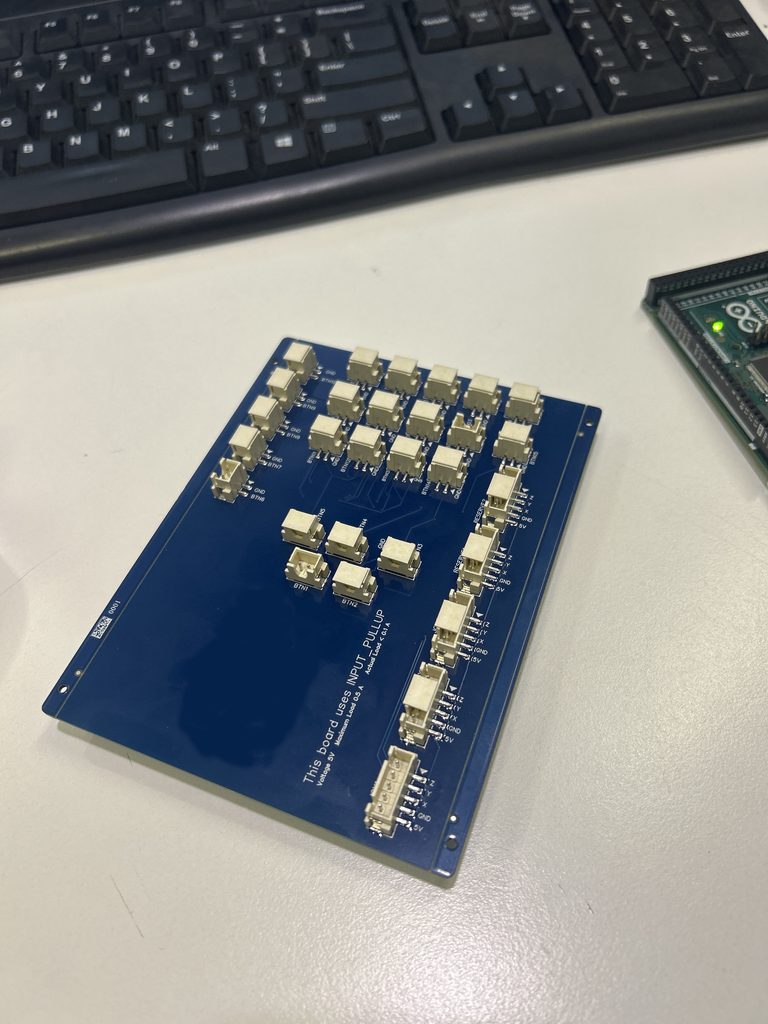
After we rescued their control board, a training-equipment maker asked us to build the next version. This latest project centered around a custom-arduino-controller-board, which now has clearer labelling, takes its power straight from the Arduino, and runs on new firmware and new Unity code.
Client: A training-equipment manufacturer (a returning client)
Users: Operators of the client’s control equipment
Services: Hardware design, System Integration
Year: 2026
Delivered: A new version of the controller board, with new Arduino firmware and new Unity software
The situation
Earlier, we rebuilt this client’s control board after the original kept reading every button as pressed. That redesign made the board reliable. In 2026, the client came back and appointed us to take the next step, specifically to further advance their custom-arduino-controller-board solution.
This time, nothing was broken. Instead, the goal was to improve a design that already worked, so the board is easier to wire, easier to understand and simpler to power.
What we improved
01
Better labelling
Every button connector shows its name and a ground pin. Each joystick connector marks 5V, GND, X, Y and Z. As a result, anyone can wire the board without a separate drawing—streamlining work on a custom-arduino-controller-board.
02
Power from the Arduino
The board now draws its power from the Arduino itself, so there is no separate supply to connect and one less thing to go wrong. With this, the power system truly embraces the advantages of a custom-arduino-controller-board design.
03
New firmware and Unity code
We wrote new Arduino firmware and new Unity software to match the new board, so the hardware and the software are designed together. This approach was central to our custom-arduino-controller-board methodology.
A board that explains itself
The last project taught us what happens when the only person who understands a board leaves. Therefore, we put the key facts on the board itself. It states that it uses INPUT_PULLUP, and it prints its voltage (5V), its maximum load (0.5 A) and its actual load (under 0.1 A). This self-explanation is one of the practical benefits of a custom-arduino-controller-board.
An engineer who picks up this board in a few years can read how it works straight off the silkscreen. In short, we built it so the knowledge stays with the hardware and is always accessible on the custom-arduino-controller-board itself.
The result
The client now has a controller board, firmware and Unity software that were built together, and a design they can wire, power and maintain without us. Meanwhile, the board keeps the pull-up inputs that fixed the original fault. This result shows the lasting value and reliability of a custom-arduino-controller-board platform.
What this shows
A rescue is often only the start of the relationship. Once the board worked, the client trusted us to improve it. In this case, the second project was not about fixing a fault, but about making a good design clearer, simpler and easier to own—a perfect example of the advantages of a custom-arduino-controller-board for specialized needs.
Need a custom controller board that connects to Unity?
We design the board, the firmware and the software together. Talk with us about how a custom-arduino-controller-board can be tailored to your project. Start with a free assessment.